Fallout 3 had an ending. It just wasn't any good.
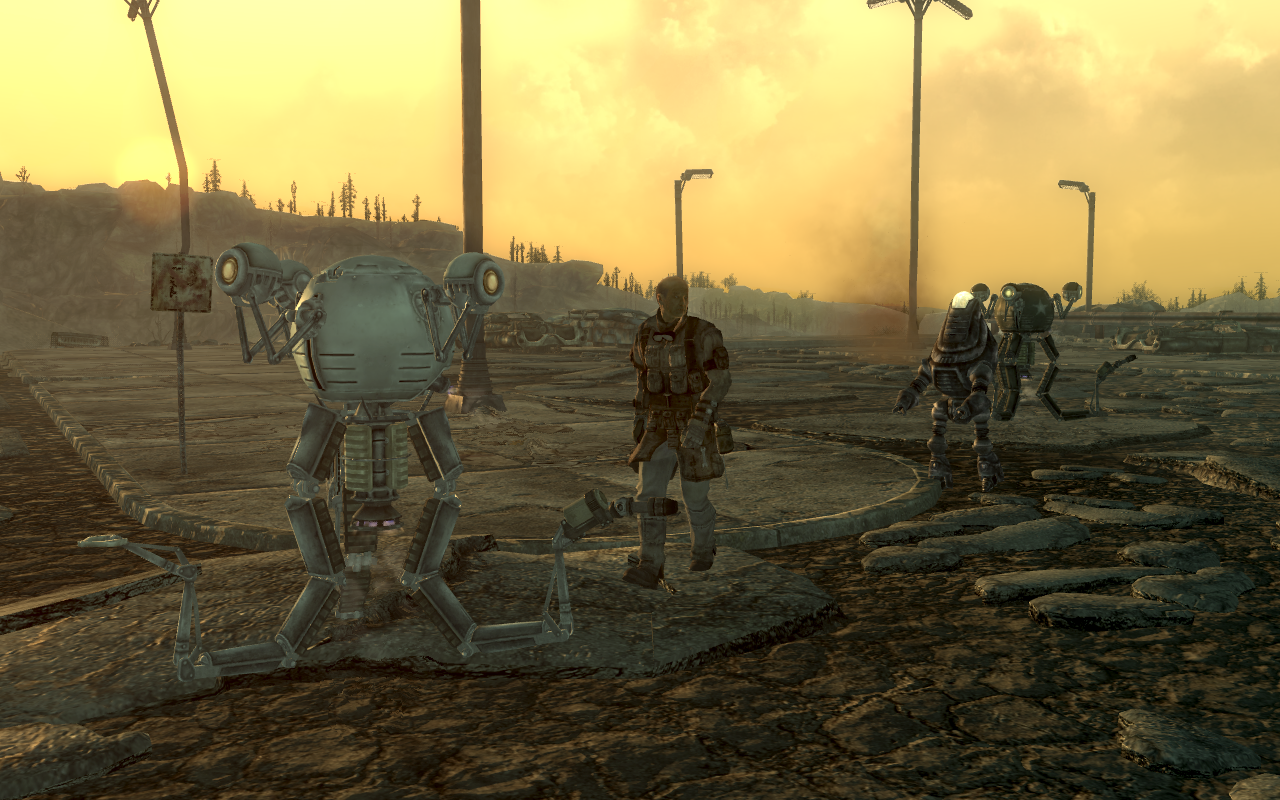
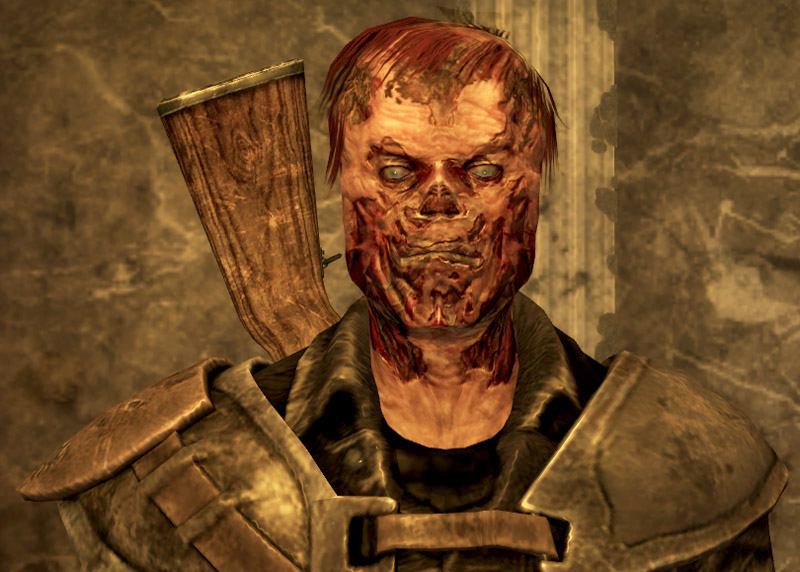
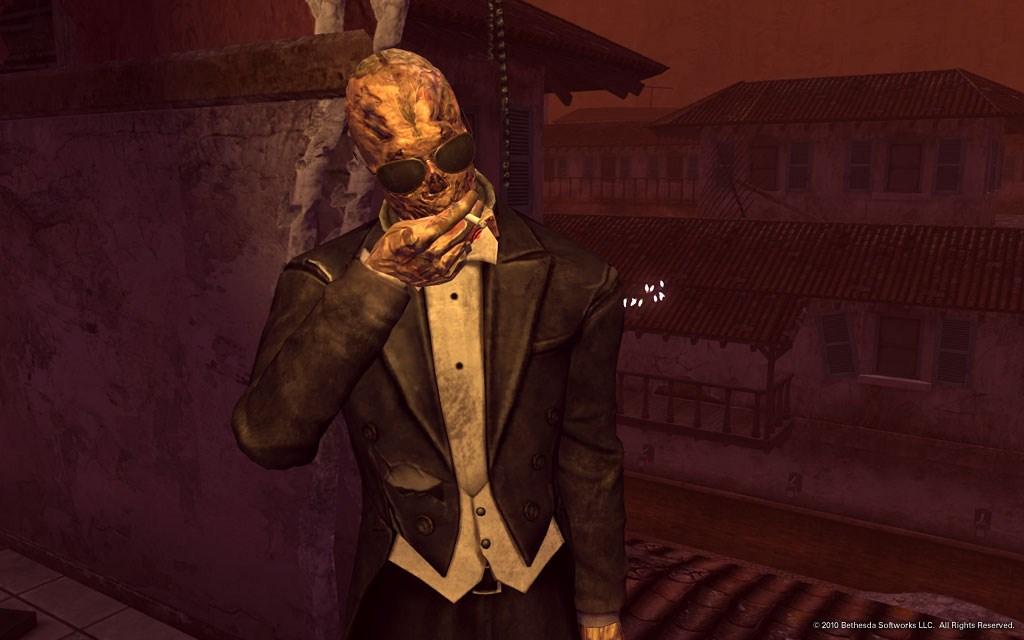
Massive spoiler warning, obvy, but the game concluded with you having to brave massive radiation in order to purify the water in the DC area, making aqua pura avaialable for everyone at the cost of your own life (or Sarah's life). Why is this such an annoyance? It's an annoyance because the lethal dose of radiation that would absolutely kill you, that would drop you into a body bag, would not harm at least three of your companions. Three of your companions who are standing by idle, waiting for you to die in the radiation that would not possibly hurt them. You have a robot, or a super mutant, or a ghoul in your party, and they're not susceptible to radiation at all, yet they still refuse to enter into the memorial, and purify the water.
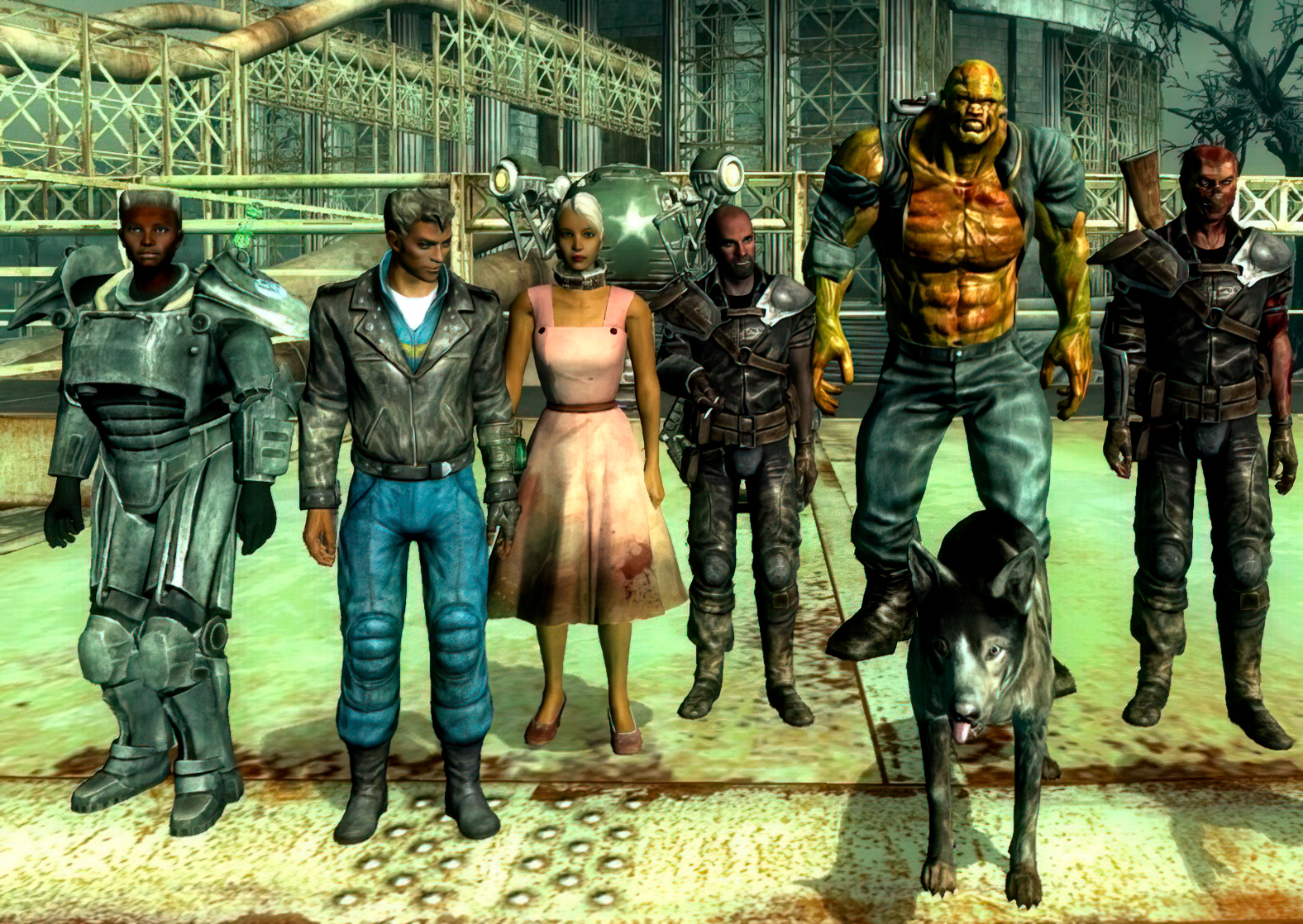
That was stupid, and it set up one of the silliest endings in video game history, that you had to choose between dying and sending someone else to their death, while you had companions standing idle who refused to enter for no good reason. Now, eventually the good producers of the game smartened up, and changed the game. For you see, Fallout 3 is an open world game, and you can go wherever you want, from the republic of Dave all the way to Arefu, and as an open world game, there's not really and
end, per se. And after they released downloadable content, they got rid of the end of the game. After you purified the water at the Jefferson memorial, the game didn't end anymore, at least not at that point. There was still fighing to be done against the enclave using Liberty One, and the broken steel add-on meant that you could continue the fight. But after you destroyed the Enclave at their base, ruining any chance they'd ever have of coming back, the game keeps going. You could move onto new DLC, you could go to Mothership Zeta, you could go to the Pitt, but the game didn't have an ending proper anymore. The credits never rolled again.
So what to do? You see, the game will point you in key directions for quite a while, helping you to see and to experience the wild wasteland, but all the quests are over at that point. There is nothing specifically left for you to do. It never really ends.
It's funny that the Book of Revelation comes up intensely in the game, up to and including the point where the game calls the final quest 'the waters of life,' directly referencing Revelation, and the end of all things. And this, this is important. It's important because the Bible ends at that point, when the sky rolls back and everything grinds to a halt. And when that happens, history is over. And the game does seem to have an Alpha and an Omega, it does seem to have a beginning and an end. Just like Christian history has a set beginning in Genesis, and a set end in Revelation. And when Jesus talks about himself as the Alpha and the Omega, he does so to say that there was nothing before him, and there will be nothing after him. And yet, after they revised the ending to the game, it didn't have an alpha and an omega anymore. Oh, sure, there was still a beginning, but there was no conclusion. After you finished the story mission, the game just keeps on going. That's what we call an open world game.
But the Christian life is essentially like an open world game, because expected progression only gets you so far. If you're like the average North American protestant, you get only so far, and they you stop. You get through Sunday school, you get through Confirmation, you get through the relative progression that leads you to 'um, now what?' The story missions are all over, and now you get to explore the open world of it all. The big, enormous open world. And then what do you do? What do you do if nobody's telling you what to do anymore?
It's a good question, and one that regularly stumps our confirmation graduates. As they get to the end of their story based missions, the main missions that drive the plot, then the game no longer holds their hands and tells them where to go. The game is still running, the world out there is still what it used to be, and there are many quests that are repeatable perpetually, but there is no more straight logical progression. And this is where we lose people, almost every time. The main story is done, the missions that lead one to another have stopped, the exclamation marks on the map are all gone, and that seems to be all there is to it.
Now, here's a quick question for those of you playing along at home. Once the kids have been confirmed and have disappeared, what is the very next time we're likely to see them?
Spoiler alert, it's this one.
What happens in the meantime? Who knows, really. The kids who disappeared, and who are only around for confirmation, marriage, and to baptize their babies, they're the ones who can't really work with an open world, in which the conditions for moving forward aren't spelled out for you. You have to find your own quests to complete, you have to find your own places to go, and your own experiences to level up with.
You see, if you spend some time in the world, you'll find your own quests to complete. You'll find a way to extend the life of the game outwards. You'll find your own responsibilities to do and to accomplish. One of the best ways that Fallout did this was to insitute a couple of factions roaming
around the wastes, who had their own goals and objectives. One of my personal favourites was after rescuing a squad of mercenaries from the rooftop of the statesman hotel, you can be enlisted into their ranks. You become one of Reilly's Rangers. And Reilly herself will offer you a suit of their battle armour to wear, and gives you a permanent, perpetual quest to map the wastes, giving you money for each location visited. And it wasn't about the money. It was about finding a way to take on that role and responsibility, about making this world my own. And I loved that armour, too. It was great to instead of wearing random pots and pans cobbled together from raiders, to wear something that marked me as part of a cohesive team.
This is vitally important to the way the game works, as it changes it from something that drags you around, shiny spot to shiny spot, into a world in which you believe that you have sincere agency. If you remember my discussion about Bioshock, that game revealed itself as being a game in which the central theme was that you didn't have control. You were led about, as a player character, from checkpoint to checkpoint, almost as though it was a racing game, and not an FPS RPG. You know how racing games work, which is that you're in a car (or kart), and the other racers are in similar cars
(or karts), and you're moving on a set path to a set destination. And there may be shortcuts, but they just take you back to the main course after a tiny deviation. And that's what Bioshock was about. It was interesting, full of life, a very pretty game with a heaping tonne of atmosphere, but the gameplay itself was linear progression through checkpoints. Now, contrast that with the way Fallout works, in which you have key quests to accomplish, but thousands of other little quests in the meantime. You can find yourself bringing water to beggars, collecting fingers for the regulators, giving money to the church on Rivet city, or any number of thousands of things that make this into a world in which things happen, and people live. And you have a choice, which is to either blaze through the game as quickly as possible, or to find pleasure in the sidetracks, and find your own reason for doing what you do beyond just what you're told to.
As I said earlier, the Christian experience, with its clear progression then open world, is like that. There are set checkpoints to attain, baptism, Sunday school, Confirmation classes, confirmation, then..... what? Then, with the open world set up before you, you get to decide your own level of immersion. There will no longer be any stars on the map, any exclamation points, instead, it's up to you to decide how deep your involvement goes. You can take on your role in Reilly's Rangers by joining a board or committee. You can become a regulator by being an elder or a trustee. You can upgrade your stats and level up in Bible study, but know that the main story quests wrapping up isn't the end of the game. It just means that you have been equipped, you have leveled up sufficiently to explore the major content before you. You are now able to take on the challenges of the open world before you. The world both of the church, and of the world itself.
Now, a quick aside before I close the book on Fallout 3. The game itself is perhaps as close as I've ever come to a genuinely immersive experience, mainly because of the open ended nature of what it asks you to do. You can talk your way out of problems instead of fighting your way out of them. You can use science and medicine to accomplish your goals. You can choose to go from main quest to main quest, or you can explore why there are an alarming number of dead bodies in a certain burned out shack. You can free slaves or make them, you can destroy towns or save them, and all the way through, the options are almost as wide open as they are in life. It's the real definition of an open world, and the only question to you as a player is how deep do you want to go, because the game, the church, life, goes as deep as you want it to.
Thursday, July 31, 2014
Tuesday, July 15, 2014
Tenpenny tower
Ugh. I don't want to write about this.
I don't want to write about this, because video games aren't supposed to give you choices like this one. They're supposed to give you easy choices. Think back to the choices that you were given going all the way through video games in the '80s. You are Mario. You jump on goombas. And that wasn't even really a moral question, since if you didn't jump on a goomba or a koopa they'd just happily walk right off a cliff anyway, without even slowing down. Well, the green shells, anyway. Pac-man ate ghosts, that was his job. And all this stuff was really simple, and framed in the good guy / bad guy framework (or the Lucas Simms / Mister Burke framework if you'd rather).
But then comes Tenpenny Tower.
Tenpenny Tower is where the moral nature of the game kicks into overdrive, and if you've ever played it, you know exactly what I'm talking about. On first glance, it's not a complicated question. Allistair Tenpenny is a bad man. We know that from first talking to him. After all, he was the one who wanted Megaton destroyed, and all its inhabitants killed, because it was an 'eyesore.' He sits on his balcony at the top of Tenpenny Tower, and looks through his sniper rifle and blasts away at ghouls and wildlife, and human visitors, in what he calls a 'wasteland safari.' This is the textbook definition of someone that you should want to execute in the game. For further proof of that, type 'Allistair Tenpenny' into the search bar in youtube. Try to find a single video that isn't a compliation of him getting murdered. He doesn't attack you, but he's obviously up to no good. He's a bigot, and the type of person who would end lives because the people who stand in his way are inconvenient.
Although there's a quest given to you from a ghoul in Underworld to kill Tenpenny, you don't have to, at least not right away. But in the areas around Tenpenny Tower, there are bigger things happening. For you see, sentient ghouls are living in the subways around Tenpenny Tower. And they're not real happy about being second class citizens. As they shouldn't be. Their spokesman, Roy Phillips, wants them to be let into Tenpenny Tower as paying residents. The ghouls are people too. People who look a little bit different, people whose skin has been wrecked by radiation (Ghouls call humans smoothskins), but people nonetheless. And these people want the same access to the luxury of Tenpenny Tower that any other paying guest would want.
And so the stage is set. The die is cast. Chief Gustav, Tenpenny's head of security, offers you money and guns to kill all the ghouls in the subway beneath the ground. When you get there, the ghouls tell you their demands. And this seems like an easy choice. Obviously the ghouls should be allowed to enter, right? They're people too. And the whole thing smacks of not-so-veiled racism. But the ghouls under the city don't exactly have a great plan either, in that they want to let a bunch of feral ghouls into the Tower to kill all the human residents, and then move into the tower after all the humans are dead. So, in the one case, you murder all the ghouls, and then get money and guns for your trouble from the bigot humans. In the other case, you help the ghouls to kill all the humans, and then they move into the Tower and take over, trying to forget all the murders that they committed to get there.
If only there was another way. Which there is.
You see, Fallout is not a shooter, or at least it doesn't have to be. You are not required to go into every situation guns blazing. When there are puzzles to be solved, the solution isn't always 'use bullet on
man.' There are alternatives to fighting. When I was making my character for the game, I put a lot of points into charisma, speech, all those things that I feel as though I would have to rely on in the wastelands. And when presented with this choice, I was relieved to find that instead of murder on one side and murder on the other side, there was an option to deal with diplomacy. You can, if you work hard enough and are convincing enough, get the humans to be less bigoted, and to let the ghouls move in alongside them. This is obviously the best of all possible solutions, in which the right thing happens. The ghouls get to enter the Tower alongside the humns, and everyone learns an important lesson about life.
And again, that's the way thing are supposed to go. Jesus tells us 'blessed are the peacemakers,' and that's a wonderful thing to aspire to. The desire when approaching a situation like Tenpenny Tower is to want to make peace, to enter into this world as the savior of the wastes, as the one who is able to
smooth out differences and disagreements, as the one who is able to make everything better and to make sure that people can both live, and prosper. We are told that throughout the scriptures, that one's goal ought to be to encourage, to help and to change the hearts of stone of those who are resistant to the word of God. He desires that all men be saved and come to a knowledge of the truth. Jesus tells us that there is always the chance to turn things around, to do the right thing, that nobody ought to be considered to be too far gone as long as they yet draw breath.
So you go, you talk to all the residents of Tenpenny Tower, you discuss their dreadfully bigotry, and you convince them one by one to let the ghouls move in. And after talking to all of them, they allow, through a great deal of conversation, the ghouls to be equal residents of the Tower. The solution is there, and everyone is happy. You shake hands with Roy Phillips, and walk away, safe in the knowledge that you did the right thing.
But if you go back to the tower, if you leave and then go back, you will find something strange. The humans who lived there are nowhere to be found. For some reason, it's all ghouls all over the place, all the time. It's surreal, that place that was inhabited by humans is all deserted. And this was the space in which you were sure that you smoothed things over and made it all better by talking nicely to everyone. It is only after talking to Roy Phillips that he tells you that he and the human residents had a 'disagreement,' and that's that. If you keep exploring the tower, you'll find where all the people went. Their bodies are all crammed into basement storage.
After all your effort of trying to make sure that the humans and the ghouls could get along, they still don't. Someone's still going to die. There will be blood in this mission. And the saddest thing of all is that after you spend forever and ever trying to convince the humans that the ghouls are people too, that they're not bad, that they're not any different than they are, that they're safe and fair and just people, and even then, the ghouls end up slaughtering them en masse, and hiding their bodies in the basement.
Bottom line: There is no good way to complete this quest. It's not even like 'Wargames' where the only way to win is not to play. If you refuse to play, if you refuse to participate, then the bigots will continue to live fat and happy in their luxury, and will be confident in their offensive oppressive nature. But if the ghouls win, the people end up dead. Whether you kill them or someone else does, they end up dead. And knowing that, there's not a good way to complete the task so that everyone prospers. Someone will lose, someone will die.
As a Christian, this is the hardest decision that there was to make, because I felt personally responsible for the outcome. I wanted to do the right thing, I wanted to do what was good and proper, I wanted the bigots to change their minds, and for them to live side by side with the ghouls, and it didn't happen. And so the question is, how much responsibility do you bear for the decisions of other people?
This is something that Christians need to consider. Your issues are your issues only. Your decisions are your decisions only. That whole proverb that tells you that you can lead a horse to water but can't make it drink, that's true. You can make all the correct decisions you want, you can bring people together, but it's not up to you to live their lives for them. You can do all you want to give them the best information possible, to make it so that they would make good quality decisions, you can discuss things with them, you can help them to see how things ought to be, but you can't take full responsibility for what they do. That's not your call to make.
This is one of the most difficult of all Christian teachings to deal with and to bear, that you are just responsible for your own morality. You can call out and punish evil, you can look evil right in the face and call it out for what it is, you can present people with all the morality you have, but their decisions
are ultimately up to them. Each one should bear his own load. This is what separates, or should separate, a Christian nation from a 'Christian' nation. The first is the one in which the majority of people internalize, live out Christian principles. The second is one in which the government will or will not allow individuals to do things based on a perception of Christian principles. You see, the Bible says that you shall not kill, and it's right to do so. No murder. But you can't kill people based on future murder that they might commit. You can't pre-emptively pull a minority report and assume that you know who will or will not turn on their fellow man.
Ultimately, what Tenepenny Tower tells you is that you are responsible for your own actions. If you got a sick feeling in the pit of your stomach when you realized what had happened, it's because the game is too smart to give you a simple black and white choice, of letting you choose the good option and eschew the bad option. Both options are bad, because both sets of people are bad. They've all got problems. Nobody leaves Tenpenny tower with all their morals and scruples intact. Or if they do, then they lose all their blood. Back in Megaton, there were good guys and bad guys. Simms and Burke. In Tenpenny Tower, you only have bad guys, and whichever pony you back, someone's going to do bad things. All you can do, as the player, is to do the right thing as much as you can, and to let the consequences for that rest on those who committed the crimes.
If I had to reload the save, and start over, I would not even touch Tenpenny Tower at all. If they want to sort this all out, they can do it on their own. But I think I still would deal with Mr. Tenpenny myself. He is my responsibility.
Tune in next week as we wrap up Fallout 3, talking about how to end an open world game that never ends.
I don't want to write about this, because video games aren't supposed to give you choices like this one. They're supposed to give you easy choices. Think back to the choices that you were given going all the way through video games in the '80s. You are Mario. You jump on goombas. And that wasn't even really a moral question, since if you didn't jump on a goomba or a koopa they'd just happily walk right off a cliff anyway, without even slowing down. Well, the green shells, anyway. Pac-man ate ghosts, that was his job. And all this stuff was really simple, and framed in the good guy / bad guy framework (or the Lucas Simms / Mister Burke framework if you'd rather).
But then comes Tenpenny Tower.
Tenpenny Tower is where the moral nature of the game kicks into overdrive, and if you've ever played it, you know exactly what I'm talking about. On first glance, it's not a complicated question. Allistair Tenpenny is a bad man. We know that from first talking to him. After all, he was the one who wanted Megaton destroyed, and all its inhabitants killed, because it was an 'eyesore.' He sits on his balcony at the top of Tenpenny Tower, and looks through his sniper rifle and blasts away at ghouls and wildlife, and human visitors, in what he calls a 'wasteland safari.' This is the textbook definition of someone that you should want to execute in the game. For further proof of that, type 'Allistair Tenpenny' into the search bar in youtube. Try to find a single video that isn't a compliation of him getting murdered. He doesn't attack you, but he's obviously up to no good. He's a bigot, and the type of person who would end lives because the people who stand in his way are inconvenient.
Although there's a quest given to you from a ghoul in Underworld to kill Tenpenny, you don't have to, at least not right away. But in the areas around Tenpenny Tower, there are bigger things happening. For you see, sentient ghouls are living in the subways around Tenpenny Tower. And they're not real happy about being second class citizens. As they shouldn't be. Their spokesman, Roy Phillips, wants them to be let into Tenpenny Tower as paying residents. The ghouls are people too. People who look a little bit different, people whose skin has been wrecked by radiation (Ghouls call humans smoothskins), but people nonetheless. And these people want the same access to the luxury of Tenpenny Tower that any other paying guest would want.
And so the stage is set. The die is cast. Chief Gustav, Tenpenny's head of security, offers you money and guns to kill all the ghouls in the subway beneath the ground. When you get there, the ghouls tell you their demands. And this seems like an easy choice. Obviously the ghouls should be allowed to enter, right? They're people too. And the whole thing smacks of not-so-veiled racism. But the ghouls under the city don't exactly have a great plan either, in that they want to let a bunch of feral ghouls into the Tower to kill all the human residents, and then move into the tower after all the humans are dead. So, in the one case, you murder all the ghouls, and then get money and guns for your trouble from the bigot humans. In the other case, you help the ghouls to kill all the humans, and then they move into the Tower and take over, trying to forget all the murders that they committed to get there.
If only there was another way. Which there is.
You see, Fallout is not a shooter, or at least it doesn't have to be. You are not required to go into every situation guns blazing. When there are puzzles to be solved, the solution isn't always 'use bullet on
man.' There are alternatives to fighting. When I was making my character for the game, I put a lot of points into charisma, speech, all those things that I feel as though I would have to rely on in the wastelands. And when presented with this choice, I was relieved to find that instead of murder on one side and murder on the other side, there was an option to deal with diplomacy. You can, if you work hard enough and are convincing enough, get the humans to be less bigoted, and to let the ghouls move in alongside them. This is obviously the best of all possible solutions, in which the right thing happens. The ghouls get to enter the Tower alongside the humns, and everyone learns an important lesson about life.
smooth out differences and disagreements, as the one who is able to make everything better and to make sure that people can both live, and prosper. We are told that throughout the scriptures, that one's goal ought to be to encourage, to help and to change the hearts of stone of those who are resistant to the word of God. He desires that all men be saved and come to a knowledge of the truth. Jesus tells us that there is always the chance to turn things around, to do the right thing, that nobody ought to be considered to be too far gone as long as they yet draw breath.
So you go, you talk to all the residents of Tenpenny Tower, you discuss their dreadfully bigotry, and you convince them one by one to let the ghouls move in. And after talking to all of them, they allow, through a great deal of conversation, the ghouls to be equal residents of the Tower. The solution is there, and everyone is happy. You shake hands with Roy Phillips, and walk away, safe in the knowledge that you did the right thing.
But if you go back to the tower, if you leave and then go back, you will find something strange. The humans who lived there are nowhere to be found. For some reason, it's all ghouls all over the place, all the time. It's surreal, that place that was inhabited by humans is all deserted. And this was the space in which you were sure that you smoothed things over and made it all better by talking nicely to everyone. It is only after talking to Roy Phillips that he tells you that he and the human residents had a 'disagreement,' and that's that. If you keep exploring the tower, you'll find where all the people went. Their bodies are all crammed into basement storage.
After all your effort of trying to make sure that the humans and the ghouls could get along, they still don't. Someone's still going to die. There will be blood in this mission. And the saddest thing of all is that after you spend forever and ever trying to convince the humans that the ghouls are people too, that they're not bad, that they're not any different than they are, that they're safe and fair and just people, and even then, the ghouls end up slaughtering them en masse, and hiding their bodies in the basement.
Bottom line: There is no good way to complete this quest. It's not even like 'Wargames' where the only way to win is not to play. If you refuse to play, if you refuse to participate, then the bigots will continue to live fat and happy in their luxury, and will be confident in their offensive oppressive nature. But if the ghouls win, the people end up dead. Whether you kill them or someone else does, they end up dead. And knowing that, there's not a good way to complete the task so that everyone prospers. Someone will lose, someone will die.
As a Christian, this is the hardest decision that there was to make, because I felt personally responsible for the outcome. I wanted to do the right thing, I wanted to do what was good and proper, I wanted the bigots to change their minds, and for them to live side by side with the ghouls, and it didn't happen. And so the question is, how much responsibility do you bear for the decisions of other people?
This is something that Christians need to consider. Your issues are your issues only. Your decisions are your decisions only. That whole proverb that tells you that you can lead a horse to water but can't make it drink, that's true. You can make all the correct decisions you want, you can bring people together, but it's not up to you to live their lives for them. You can do all you want to give them the best information possible, to make it so that they would make good quality decisions, you can discuss things with them, you can help them to see how things ought to be, but you can't take full responsibility for what they do. That's not your call to make.
are ultimately up to them. Each one should bear his own load. This is what separates, or should separate, a Christian nation from a 'Christian' nation. The first is the one in which the majority of people internalize, live out Christian principles. The second is one in which the government will or will not allow individuals to do things based on a perception of Christian principles. You see, the Bible says that you shall not kill, and it's right to do so. No murder. But you can't kill people based on future murder that they might commit. You can't pre-emptively pull a minority report and assume that you know who will or will not turn on their fellow man.
Ultimately, what Tenepenny Tower tells you is that you are responsible for your own actions. If you got a sick feeling in the pit of your stomach when you realized what had happened, it's because the game is too smart to give you a simple black and white choice, of letting you choose the good option and eschew the bad option. Both options are bad, because both sets of people are bad. They've all got problems. Nobody leaves Tenpenny tower with all their morals and scruples intact. Or if they do, then they lose all their blood. Back in Megaton, there were good guys and bad guys. Simms and Burke. In Tenpenny Tower, you only have bad guys, and whichever pony you back, someone's going to do bad things. All you can do, as the player, is to do the right thing as much as you can, and to let the consequences for that rest on those who committed the crimes.
If I had to reload the save, and start over, I would not even touch Tenpenny Tower at all. If they want to sort this all out, they can do it on their own. But I think I still would deal with Mr. Tenpenny myself. He is my responsibility.
Tune in next week as we wrap up Fallout 3, talking about how to end an open world game that never ends.
Wednesday, July 9, 2014
Making good decisions in Fallout 3
For those of you who don't know, here is some background into the fallout series. Some really brief background. The nuclear war that we were all terrified was going to happen? It happened. October 23rd, 2077, the war began. Most of humanity were wiped out, of course, with us still having enough nuclear weapons to wipe us all out several times over. But there were people who survived, a generous number of whom were living in massive underground vaults, which would protect the inhabitants in case of nuclear war. That they did, leaving the massive fireballs and nuclear fallout to reduce the world outside to essentially rubble, and leaving the people outside the vaults to either die in the conflagration, or die of radiation sickness, or turn into ghouls. Ghouls are humans who survived the nuclear war, although not without some side effects, as they have lost their hair, their skin has decayed to make them look like walking corpses. And most of them have turned feral.
The world outside still has the vague image of the world that was, but by the time you get to it, it's all broken. The world that humanity made, with its humorous 1950s robots, its industry, its homes and
airplanes, it's all broken now, all smashed. The people who are left outside, they're essentially living day to day, and just trying to scrape by. There are good people and bad people, and all sorts of morally dubious people, and it is this world that you come to, and decide how you're going to play.
Now, spoiler alert, I played this wrong. When your vault opens, and you are able to leave, you are sort of supposed to go towards the massive obvious town just past the vault. That's the town that sprang up around the vault, hoping one day that the vault would open back up, and they'd be let it. It was also the town built up around an unexploded bomb, Megaton. And I gleefully walked right by it, and into the wasteland. And yes, I got all kinds of lost, and turned around, and ended up fighting enemies way too difficult for me. And that was fine. But after stumbling back to the place where I was supposed to go in the first place, the moral dilemmas begin. Because, you see, there are good and bad options available everywhere. There are thing to do that are both right and wrong all over the place, and usually they're pretty simple to figure out.

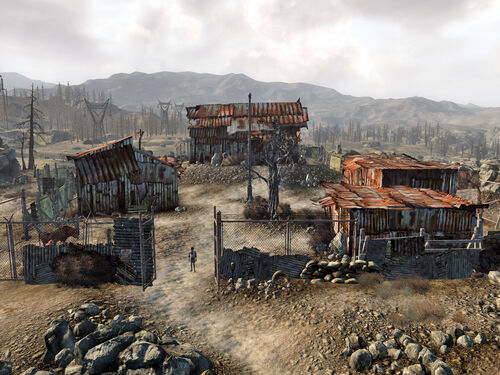
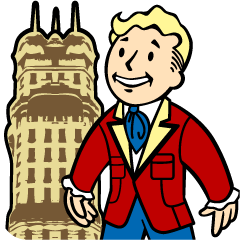
The simplest of all happens in Megaton. It's easy primarily because of the whole white hat black hat dichotomy that is so popular. Let me introduce you to Mister Burke. Here he is. Did you notice his black hat and shifty eyes? He is wearing a suit, has a black hat on, and is essentially offering you money to blow up the town of Megaton, killing everyone inside. Now, this is obviously, cartoonishly evil, really. There's no good reason to go along with his plan to murder everyone in the town by setting off the atomic bomb, but that's the offer on the table. The only reason for blowing the town up is that Alistair Tenpenny, the ruler of nearby Tenpenny tower, thinks that it's ugly. Yes, that the town of Megaton is a blight on the landscape. A post-apocalyptic landscape that looks like this:
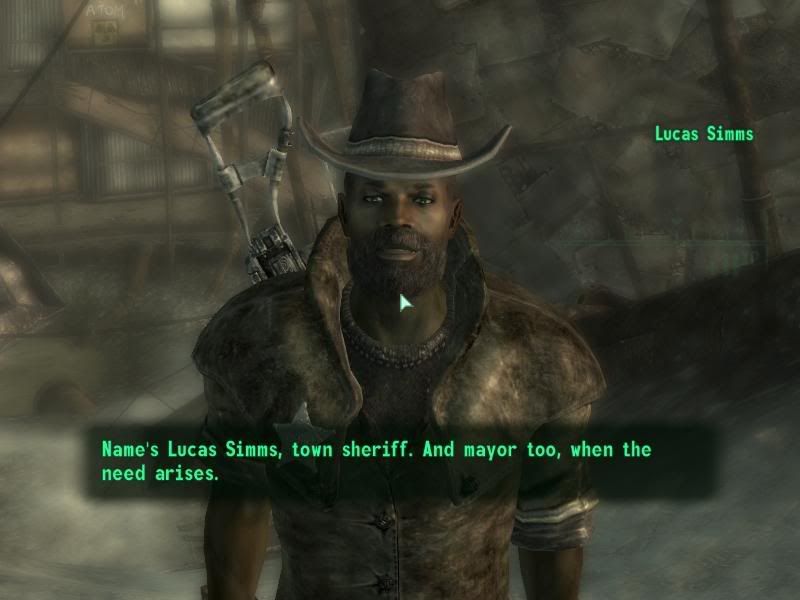
It really couldn't look any more blighted, but there we are. So you've got a guy in a black hat offering you money to blow up a town because it for some reason looks uglier than the rest of the blighted landscape, and that's the whole motivation. And the guy that you'd have to get rid of and stand against to blow the town up is Lucas Simms, mayor and Sherriff of Megaton. There he is in his cowboy hat and sherriff's badge, looking the part. And looking at this, it's pretty obvious which choice is the one that you're going to make with a good character, and which one you're going to make if you're trying to build up an evil character.
Lucas Simms is the good guy. And as the good guy sherriff, there's a good chance that he's going to die in this exchange. Either you'll blow him to kingdom come with the bomb, or you'll find that when you report Burke to the authorities, Burke will kill Simms before you can get a shot off on him. Fine fine fine. And if you tried to, or succeeded at rescuing Simms, Burke dies, the bad guy gets removed, order is restored, and all that. But then you learn about the bobblehead.
In Fallout, you have stats. And your base stats are pretty well set. They don't go up that much. You can get equipment that helps, and weapons that help, and you can wear outfits that buff you up, and take chems (drugs) to help out, but your base stats are locked for the most part. But finding bobbleheads changes that. If you find a bobblehead, your stats go up permanently, and it's one of the few ways to do it. But this bobblehead is located in Lucas Simms' house. His locked house. His locked house that you have to break into to access. And if you get caught picking the lock, the town will turn against you and try to kill you. So you have to sneak in, in order to steal from the Sherriff.
The world outside still has the vague image of the world that was, but by the time you get to it, it's all broken. The world that humanity made, with its humorous 1950s robots, its industry, its homes and
airplanes, it's all broken now, all smashed. The people who are left outside, they're essentially living day to day, and just trying to scrape by. There are good people and bad people, and all sorts of morally dubious people, and it is this world that you come to, and decide how you're going to play.
Now, spoiler alert, I played this wrong. When your vault opens, and you are able to leave, you are sort of supposed to go towards the massive obvious town just past the vault. That's the town that sprang up around the vault, hoping one day that the vault would open back up, and they'd be let it. It was also the town built up around an unexploded bomb, Megaton. And I gleefully walked right by it, and into the wasteland. And yes, I got all kinds of lost, and turned around, and ended up fighting enemies way too difficult for me. And that was fine. But after stumbling back to the place where I was supposed to go in the first place, the moral dilemmas begin. Because, you see, there are good and bad options available everywhere. There are thing to do that are both right and wrong all over the place, and usually they're pretty simple to figure out.
The simplest of all happens in Megaton. It's easy primarily because of the whole white hat black hat dichotomy that is so popular. Let me introduce you to Mister Burke. Here he is. Did you notice his black hat and shifty eyes? He is wearing a suit, has a black hat on, and is essentially offering you money to blow up the town of Megaton, killing everyone inside. Now, this is obviously, cartoonishly evil, really. There's no good reason to go along with his plan to murder everyone in the town by setting off the atomic bomb, but that's the offer on the table. The only reason for blowing the town up is that Alistair Tenpenny, the ruler of nearby Tenpenny tower, thinks that it's ugly. Yes, that the town of Megaton is a blight on the landscape. A post-apocalyptic landscape that looks like this:
But one of the things Fallout does and does really well, is to be exceptionally hard. Not hard in the sense of traditional gaming, which is to say that if you don't press buttons at the right time, then you'll die and have to start over. No, the game is straightforward to progress in. You have guns, mines, and a hilarious method of pressing a button to pause time and target the individual arms, legs, and torso of enemies. They don't have that on you. So, yes, it's a simple enough game to progress in. What isn't simple, though, is how they set up the moral choices for you. This moral dilemma of whether to side with Lucas Simms or Mister Burke, it should take you all of five seconds to figure out. The good option is to side with the Sherriff, the bad option is to side with the cartoonish villain. But the interesting thing comes up afterwards, and this is where the game shines.
And as I say, this is where the game really shines. It's not hard choosing sides between Simms and Burke, that part's easy as pie. Simms is the good guy, Burke is the bad guy, and unless you're going for all out black hat bonanza, you're going to want to steer clear of siding with Burke. But the bobblehead is something you really want. It's sitting there, taunting you with its flexed muscles, and you know that the only way to get it is to steal it. You can search for whatever wikis you want, but there's really no way to break into that house that is clean. And you realize that these moral choices are muddier than you thought they were .
Now, you may say that taking this bobblehead doesn't count as stealing, and that's true. The game's system of Karma won't punish you for taking it directly, but it will punish you for breaking into the house, and for taking anything else in the house, even if nobody's watching. Oh, sure, if you're really sneaky you can get into the house without anyone watching, and take things without being seen, but you'll lose karma regardless, because karma doesn't depend on who is watching. Moral actions are not based on getting caught.
In this sense, Luther's explanation to the commandments is important. Martin Luther tells us that it isn't enough to not technically steal, but that we should help our neighbor to keep what is theirs, and to work hard to sustain their possessions. Even if it's something that we want. And this is the hard part about playing Fallout, that the big moral choices are easy to make, like whether or not to blow up a city, but the small ones are incredibly hard. And in that way, it mirrors life. Oh, sure the commandment to not murder is a simple one on the surface. Don't kill people, easy peasy. And on the surface, the commandment to not steal is easy too, but then you may ask yourself, if it's something you really want, 'would anyone notice?' You can easily claim that nobody would see, that you could get away with it, that Simms wasn't using it anyway, and all that. You could claim that, but every time you hear that 'you've lost karma' noise, and the little devil face shows up at the top of the screen, you know that it's not about getting caught. It's about doing what's right. And sometimes, and quite frequently, both in life and in Fallout, doing what's right is a lot different than doing what is easiest.
Next week, we're going to get into the hardest decision in the whole game, which has a lot to do with Tenpenny Tower.
PJ.
Thursday, July 3, 2014
ADAM and Eve's Garden. Bioshock part 3.
of Rapture, the residents have become so spliced up with ADAM that they are all addicted, and have begun to fall apart. Their bodies and more especially their psyches are breaking down. Most of the enemies that you face, standard enemies at least, are wearing masks leftover from celebrations, or from work. Very few of their faces can be seen, and when they are, it is horrible to behold. Their faces are disastrous, holdovers from horrible splicing accidents in which people got so hooked on modifying their own genes that they couldn't stop. And if ADAM is the raw form of the sea slug stem cells, then EVE is the power that drives it. The ammunition for your plasmids is known as EVE, a blue syringe that you inject into your wrist to power your plasmid weapons.
ADAM and EVE. You'd have to be napping to miss that this is a Biblical reference, a direct one, but what is it saying to us? Well, to begin with, it's talking about creation, really. About remaking creation, and starting again.
Remember the story of the flood? Sure you do. When big budget Noah and his Darren Aaronofsky family drifted away in a CGI Ark (I haven't seen the movie yet, so be nice) and took two of every kind of animal on board? Well, creation started again after that flood, what with all the animals having to get to work to repopulate, and what with all the human beings having to do what human beings do to repopulate. But when God either made people in the garden of Eden, or when he saved them through the Ark, he told them to be fruitful and multiply, because they were made in the image of God.
Well, imagine if you had the chance to improve on that design. Imagine for a moment if you had the ability to improve on what God had given to you as a human being, and you had the chance to augment yourself. That's the essential plot of Deus Ex (which we will get to, promise), that there are choices out there to improve on God's design, and to make something new, and perhaps better. The slogan of the plasmid advertisements is 'EVOLVE TODAY,' giving the not so subtle promise that evolution, the system that makes you faster, taller, stronger over thousands of generations, is available to you all at once, all in one injection.
The allure of ADAM in Bioshock is that it rewrites your genes, and makes you stronger, faster, more dangerous. It gives you superhuman powers, lets you freeze your foes, trap enemies, use telekenesis, and much much more. In other words, it takes the human, and makes it superhuman. But at a terrible cost.
What you realize when you walk around the ruined city that is Rapture, is that if there ever was any Rapture in that city, it was a long time ago. Given the ability to remake creation exactly as we want, given the power and authority to reach into creation and remake ourselves into what we would want to be, we can't stop. The collapse of the city is neatly summed up in the idea that ADAM is what everyone wants, but only as a means to an end. The end being human, even superhuman perfection. But as people kept on swapping parts in and out, as they kept on modifying themselves to make themselves greater, better, faster, something happened, which should have been obvious. They became less human. I know, who would have thought that spurning your humanity would make you less human, but here we are. And as they became less human in appearance, their personalities degenerated as well, and they became monsters, only living to modify themselves again. And so they all wear masks, to hide what they've all become, and even as they know that they're ashamed of what they're turning into, they can't seem to stop.
So, why are you wearing a mask? Not a real one, obvy, but a spiritual, moral, ethical mask. Why are you wearing it? What are you hiding.
The people loved darkness rather than light for their deeds were evil.
People have been falling short of God's glory for quite a while, and this is no exception. The further you fall, the more you have to cover and hide. And the funny thing is, most of our falling from grace was done to improve ourselves, it was done to make us better, it was done so that we might be more than we are. Our sins are usually committed for our own benefit, because we feel as though that will make us better. and you know, it usually doesn't. We do so many things to try to improve on God's design for our lives, what he would have us do. We add more rules, we add more ethics, we bend his rules, we decide to break them, and as that goes on, we add more and more and more, and we can't seem to stop ourselves, until one day we wake up, and realize that we can't let anyone see us the way we are. This goes double for those of us in the church, because Christians can't EVER let other Christians see them for who they are. The level of scandal attached to that would be immense and intense. Your only hope as a Christian is to hope that none of the other Christians around you ever figure out what you have turned into. And so We all wear masks, and the longer you wear masks, the more difficult it is to take them off and walk away.
The beginning of the Christian walk, though, is understanding that although you wear a mask, although you love darkness so that nobody can see your deeds, they're still obvious as all get out. Everyone knows. Your mask is not convincing at all. It sticks out a mile. From the very beginning of Bioshock, the very first splicer you see is obviously not a normal person, and none of them are. The mask can cover the face, but it can't cover that the face is messed up, and needs help. The Christian experience is predicated on the notion that you can't hide your sin behind a mask. Not only can your peers tell, but Jesus can tell. And what he wants to give you is not a new mask, but to restore your face to the point that you won't need a mask anymore.
And that was the one thing that the splicers couldn't have. They couldn't go back, they couldn't go back to be human again. Every new splice drove them further and further down the pit, and further away from what they desperately wanted after a while, just to be normal. Just to be human.
This is where the story of Bioshock turns around a human element. ADAM and EVE work together to create a new world, in which you're not bound by anything, no laws, no rules, no morality, and no limits on what you can do to yourself. You can be whatever you want to be. And the following of ADAM, of the old Adam, always leads to the same path. If you can choose whatever you want, you habitually choose nonsense. If you've ever wondered (and you probably haven't) about the old Norse gods, the old Greek or Roman gods, whoever was in the pantheon, you'll find that they are just human beings writ large. The gods of the ancient world were capricious and rude; dangerous as enemies, and perhaps even more dangerous as friends. When the ancient people sat down and mused on the possible personalities of the gods, they did so imagining what they would be like if they had unlimited power and could not die. How would they behave? What would they get up to?
By the time that these things were fully thought out, the only conclusion was that if you had unlimited power, then you'd use it to make incredibly bad decisions. You'd use it to be a monster in your own world. And that's what we see happening in Rapture. All the good intentions, the possible uses for Incinerate, Electro Bolt, Telekenesis, the ads that talk about how they'd be useful for household chores, but the power corrupts, and turns the users into monsters.
So the Christian story isn't one of improvement, so much as it is a story about resurrection, and reformation. The central thesis of the Christian faith is that Jesus lived, died, and rose again, and in rising again, restored us to righteousness with God. What does that mean? That means that we are not being re-created, we are being restored to the way things ought to be. The sin in our lives is a major issue, and it is what Jesus promises to take away, and does so. In doing so, he doesn't take the human and make it superhuman, he takes the subhuman, the broken, the corrupt, the smashed, and makes it fully and completely human again. Heaven isn't a promise of something magical, something superhuman, but the promise of a restoration to the way things should be. The Bible ends with a discussion of a new heaven and a new earth, in which people are placed, as they were in the beginning. A restoration to the way things should be, a restoration to what is good and right.
The final moment of the game, the ending, deserves a mention. People didn't really like it, and I can understand why. It seemed like kind of a letdown, but here we go. The game ends with Jack, the protagonist, returning to the surface, and the type of ending you get is dictated by how you treated the little sisters in the game. Did you harvest them, or did you save them? If you saved them, you get the good ending, in which you raise them as daughters, and they achieve normal human lives. If you harvested them, then you find a sub full of nuclear weapons, and threaten to blow up the world. That's it, there's really no middle ground. If you chose to harvest / kill the vast majority of the little sisters, the voiceover will be angry. If you saved most, but killed many, then you will get a sad voiceover. But hidden in there is something notable - you are allowed one kill. If you are moving through Rapture, and you kill the first little sister you find (or the second, or tenth, but it's usually the first), but rescue the rest, you can still get the good ending. Because there is, in the game, a chance for repentance. You can live through doing something horrible, and change your mind, be shocked by your own callousness, and repent, and turn from your sin, and still be welcomed into post-game paradise. The game really only lets you fail if you stop caring, and if you see the weak and helpless as a means to your ends.
Thanks for reading. Tune in next week for Fallout 3, and moral dilemmas in games.
This is where the story of Bioshock turns around a human element. ADAM and EVE work together to create a new world, in which you're not bound by anything, no laws, no rules, no morality, and no limits on what you can do to yourself. You can be whatever you want to be. And the following of ADAM, of the old Adam, always leads to the same path. If you can choose whatever you want, you habitually choose nonsense. If you've ever wondered (and you probably haven't) about the old Norse gods, the old Greek or Roman gods, whoever was in the pantheon, you'll find that they are just human beings writ large. The gods of the ancient world were capricious and rude; dangerous as enemies, and perhaps even more dangerous as friends. When the ancient people sat down and mused on the possible personalities of the gods, they did so imagining what they would be like if they had unlimited power and could not die. How would they behave? What would they get up to?
By the time that these things were fully thought out, the only conclusion was that if you had unlimited power, then you'd use it to make incredibly bad decisions. You'd use it to be a monster in your own world. And that's what we see happening in Rapture. All the good intentions, the possible uses for Incinerate, Electro Bolt, Telekenesis, the ads that talk about how they'd be useful for household chores, but the power corrupts, and turns the users into monsters.
So the Christian story isn't one of improvement, so much as it is a story about resurrection, and reformation. The central thesis of the Christian faith is that Jesus lived, died, and rose again, and in rising again, restored us to righteousness with God. What does that mean? That means that we are not being re-created, we are being restored to the way things ought to be. The sin in our lives is a major issue, and it is what Jesus promises to take away, and does so. In doing so, he doesn't take the human and make it superhuman, he takes the subhuman, the broken, the corrupt, the smashed, and makes it fully and completely human again. Heaven isn't a promise of something magical, something superhuman, but the promise of a restoration to the way things should be. The Bible ends with a discussion of a new heaven and a new earth, in which people are placed, as they were in the beginning. A restoration to the way things should be, a restoration to what is good and right.
The final moment of the game, the ending, deserves a mention. People didn't really like it, and I can understand why. It seemed like kind of a letdown, but here we go. The game ends with Jack, the protagonist, returning to the surface, and the type of ending you get is dictated by how you treated the little sisters in the game. Did you harvest them, or did you save them? If you saved them, you get the good ending, in which you raise them as daughters, and they achieve normal human lives. If you harvested them, then you find a sub full of nuclear weapons, and threaten to blow up the world. That's it, there's really no middle ground. If you chose to harvest / kill the vast majority of the little sisters, the voiceover will be angry. If you saved most, but killed many, then you will get a sad voiceover. But hidden in there is something notable - you are allowed one kill. If you are moving through Rapture, and you kill the first little sister you find (or the second, or tenth, but it's usually the first), but rescue the rest, you can still get the good ending. Because there is, in the game, a chance for repentance. You can live through doing something horrible, and change your mind, be shocked by your own callousness, and repent, and turn from your sin, and still be welcomed into post-game paradise. The game really only lets you fail if you stop caring, and if you see the weak and helpless as a means to your ends.
Thanks for reading. Tune in next week for Fallout 3, and moral dilemmas in games.
Thursday, June 12, 2014
Bioshock part 2 - Free Will
Ah, free will.
This is at the core of the entire Bioshock ethos. From beginning to end, from start to finish, free will is woven so desperately into the fabric of the game as for it to be pretty much the central theme of the game. Now, there will be massive spoilers this time, so if you don't want to have the game spoiled for you, then please stop reading now, play Bioshock, and then get back to me.
Good, moving on.
When the game opens, in the airplane, though you don't know it yet, your free will is already shot. The box that you hold on your lap has a small note affixed to it that you would almost miss if you weren't paying close attention. In fact, most of us DID miss it the first time. Such a small detail.
Would you kindly. Those three little words at the centre of so much. You see, this game, Bioshock, calls into question exactly what it means to follow a linear video game story. After playing it, you probably had a brief moment when you relived old video games, and asked yourself 'huh. Why DID I jump on all those turtles in Mario? Why DID I shoot all those aliens in Duke Nukem?' These are good questions, and Bioshock opens them all up. For you see, you, as a player, had no idea that your hand was being forced for the entire game. There was someone off camera giving you suggestions that you had no control over. The phrase 'would you kindly' ended up being a trigger mechanism, as when those words were spoken, you had no option but to follow through with the order. And for a huge chunk of the game, you had no idea that you were being led like a dog from task to task by that simple phrase.
This is what this game is all about. Free Will. As Andrew Ryan says, in his view, a man chooses, and a slave obeys. And the game hangs on that idea.
There's a part in the game where you end up in Eve's Garden, which I'll call a burlesque show, which is being incredibly generous. And the slogan for this burlesque show at Eve's Garden is
Come bite the apple. Come bite the apple, give in to temptation. And this is perhaps the most obvious of the hints that the concept of free will is being ever so subtly tweaked around. For you see, Eve and Adam were talked into eating the fruit by Satan, who tempted them with seductive promises, even though they had free will. But how free is free will?
In Ryan's Rapture, free will surely isn't free at all. Eventually, you end up acquiring the ability to hypnotize other enemies, splicers, and eventually the Big Daddies, and they do your bidding, which is precisely the role that you as the player are performing as the protagonist of the game. Your will is bound, and you follow orders slavishly.
Now, as Lutheran Christians, we understand this concept perhaps better than most. From the beginning, people were made with free will, but when they ate of the fruit, (bit the apple, as Eve's garden would proclaim), their will itself was corrupted. That meant that they were unable to free themselves to choose to do good things, or to choose to worship God, and cling to him. Their will was in full and complete bondage to Satan.
Now, here's the deal. This is not just an Adam and Eve problem. This is an us problem We inherit a great deal of things from our parents, size of nose, baldness, all that stuff. And along with that, we inherit this bondage of our will. We inherit concupisence. This means that a man chooses, to be sure, but a slave obeys.
We are children of Abraham, and have never been slaves of anyone
I tell you the truth. Any man who sins is a slave to sin.
As usual, stern words from Jesus, and they are especially insightful when staring down the various philosophies of Rapture. In Rapture, as in Atlas Shrugged, there is such a heavy emphasis placed on the triumph of will, on free will being sovereign, on those who are clever and thoughtful and brilliant having the will to toss off the shackles of convention that bind and hold down the entire world, and yet in Rapture, your will is so heavily constrained as to make deviating from that path impossible.
In the end, you are played for a chump by a voice in your ear that ends up betraying you. Atlas, the friendly voice you'd heard since stepping off of the bathysphere, ends up being, shall we say, not what he appeared, and his voice, playing to the best of your intentions, ends up leading you to do only what he wants you to do.
Of course, there is a redemption arc in this story, as there should be. There's a redemption arc, but thankfully, it doesn't happen at the end, as you would expect it to. It happens close to the middle. After Atlas turns on you, and leaves you to die, after the voice that was whispering to you to bite the apple leaves you to the consequences of your sins, you are saved.
This shouldn't mean anything. After all, the vita-chambers scattered through Rapture have been saving you this whole time. Whenever you die, you just come back to life again, with no trouble whatsoever, but after Atlas turns on you, you are saved not just in body, but in will. Dr. Tennenbaum, perhaps the only sympathetic character in the entire game, is able to undo the trigger word embedded in your psyhche. Instead of being captive to the suggestions of Atlas in your ear, you are free to follow your own path. And in fact, knowing how he was trying to control you makes it all the more laughable that he continues to do so.
You see, the salvation of the character of Jack, the player, in Bioshock, happens when his will is saved, and not through his own doing. Jack doesn't exert his will, he doesn't rise above the challenge, he doesn't claim anything through sheer force of will. He is saved by Tennenbaum, who frees him from the suggestion trigger, and allows him to make his own decisions.
This is precisely what we say happens upon Christian baptism. That without God\s salvation, we couldn't choose God, we couldn't decide to worship him, we couldn't decide to follow his words or edicts. We were held completely captive in our will in the same way Jack was, even without knowing it. But when God acts upon us, our will is regenerated, and we can begin to do what is good and pleasing to God. Without his work, we are endlessly hostile to him, but with his work, we are able to be good and God pleasing.
I suppose that this would be the best time to talk about the moral choice aspect of this game. This is one of the few aspects of the game that is not tightly controlled, and in which you have some degree of latitude, where you encounter little sisters throughout the game, who have sea slugs embedded in their bodies to help them to draw ADAM out of corpses. These little sisters can , upon the defeat of their big daddies, be harvested, or released. This choice is not controlled by Atlas, and is up to the player - if Jack harvests the little sisters, then he gets a bigger ADAM boost. Or so it would appear. The penalty for doing the wrong thing in this case is almost non-existent, as the little sisters give a smaller boost, but then continue to reward the player regularly though the game - something they would find very difficult to do if they had died.
In this game (unlike in a fallout game, which we will get to. Promise), the moral choice is obvious. Kill little girls, or save them. And that choice was so easy to make that I made it consistently all the way through the game, and was rewarded with the 'good' ending. But being that it is such an obvious choice, it is a dull one, too. The only area in which you have a strongly indicated moral choice is the area in which the choice is so obvious as to not even be worth talking about. The game rewards good behavior, and punishes bad, both in game, and in the ending. So then, far more interesting is the notion of the illusion of choice, and how that affects the life of the bondage of the will of the everday human being, while the temptation to bite the apple remains out there.
Free will is a fascinating question, both in-game, and out of it. The idea that we have liberty of will is something that we desperately want, we want to be captains of our own ships, and masters of our own domains, and yet in almost all circumstances, we end up doing things we'd rather not, we make decisions that we'd rather not make. We end up frequently falling into old traps and habits, we kick ourselves time and time again, in the throes of regret, asking ourselves 'why did I do that?'
Paul puts it this way, when he says about himself:
Free will is a fascinating question, both in-game, and out of it. The idea that we have liberty of will is something that we desperately want, we want to be captains of our own ships, and masters of our own domains, and yet in almost all circumstances, we end up doing things we'd rather not, we make decisions that we'd rather not make. We end up frequently falling into old traps and habits, we kick ourselves time and time again, in the throes of regret, asking ourselves 'why did I do that?'
Paul puts it this way, when he says about himself:
We know that the law is spiritual, but I am unspiritual,
sold as a slave to sin. I do not understand what I do. For what I
want to do I do not do, but what I hate, I do. And if I do what
I do not want to do, I agree that the law is good.
As it is, it is no longer I myself who do it, but it is
sin living in me...
Although I want to do good, evil is right there with me.
For in my inner being I delight in God's law, but I see another
law at work in me, waging war against the law of my mind
and making me a prisoner of the law of sin at work within me.
What a wretched man I am! Who will rescue me from this
body that is subject to death? Thanks be to God, who
deilvers me through Jesus Christ our Lord!'
Romans 7:14-17,21-25
Bioshock is the first game to really explore this space, to ask the player character why they make the decisions they make. Is it because they want to, or because they are compelled to? These are useful and helpful questions to ask in the life of the Christian as well, especially in the light of the seventh chapter of Romans. Tune in next week for the conclusion of Bioshock.
PJ.
Friday, May 23, 2014
Bioshock, part one.
I know, I know, this game has been done to death, but hold on, there's still some things to say.
If you are well aware, you'd know that I've been working through Ayn Rand's 'Atlas Shrugged' for quite some time. It is exactly what you think it is - essentially a long tale all about how the ambitious ought to be encouraged in their ambition, because everything in civilization ultimately rests on it.
Knowing this is ultimately important for the rest of the Bioshock story, as it tells a tale of a world in which all the restrictions are removed. Bioshock is a game by Ken Levine's Irrational Studios, released in 2007. It tells a story of a world in which the scientist is not restricted by morality, in which the artist is not restricted by the censor, in which the great is not constrained by the small. In other words, according to secondary antagonist Andrew Ryan, it is rapture.
And here's where the story really starts. You are an unknown, essentially silent protagonist, whose airplane just happens to crash in the waters of the Atlantic Ocean, conveniently right next to a lighthouse in the middle of nowhere. You are, ostensibly, the only survivor, and floating in the waters as the wreckage of the plane sinks around you, your only choice is to swim towards the lighthouse, whose door is open, and where the music of Bobby Darrin's 'beyond the sea' greets you.
What else greets you? The massive face of a bust of Andrew Ryan, surrounded by his motto
When Andrew Ryan narrates your descent into the briny depths, he asks who owns the sweat of a man's brow? The man in Washington says it belongs to the poor. The man in the Vatican says it belongs to God. The man in the Kremlin says it belongs to everyone.
As the bathysphere you are in descends, you look out over the sprawling city of the ocean floor, and you see fish, and a massive whale, and a giant squid swimming by. And you realize that this is going to be where all the action happens. Under the sea.
For a game underwater, there is no swimming gameplay. At all. It's all walking and using bathyspheres. But hold on, because the underwater setting exists primarily as an interesting way to maroon the cast beyond the reach of anyone else. Rapture has to be able to exist outside the rest of the world in order for it to remain a realistic project, but also have plenty of the fantastic attached to it. And as you walk through Rapture, something strange crops up before almost anything else in the entire story. Everything is for sale.
When I say everything is for sale, I mean everything. All things in this world are for sale, and are closely monitored. There is no charity here, no welfare, no public works. If you want something, you will be paying for it. Food, drink, even the air itself is for sale. Nothing is free. Right after you get into the first bathysphere, before Ryan's speech, you see an ad for a plasmid, one of the many things in this world that are for sale.
So in a world that is for sale, in which you can buy anything you want, in which there is no censorship, and there are no restrictions, how could there possibly be any contraband? But there is contraband. There's always contraband.
If you make it far enough into the game to stumble across the camps that smugglers have left behind in the bowels of Rapture, you'll find that there are smuggled crucifixes and smuggled Bibles in crates that are definitely listed as complete contraband, and are excessively illegal in Rapture.
As you move through the world that Ryan has created under the sea, you realize that his world hinges on there being no censorship except censorship of ideas he doesn't want. Ideas of altruism and faith are quashed right away, and in Ryan's world cannot be allowed to spread, given that everything depends on self-interest. If enough people start demanding charity and hands-on government, then his entire city washes away before his eyes.
All this speaks to the incredibly counter-cultural nature of the Bible, and of the faith that it embodies. Jesus famously said to his disciples who were looking on 'give unto Caesar what is Caesar's, and give unto God what is God's' and the people marveled at his teaching. He was being put into a situation in which the Hebrews who were there were asking him if it was lawful to pay taxes, and Jesus turned the question on its head. For Jesus, his kingdom was not of this world, and because it was not of this world, then his kingdom, and his word, could remain staunchly and stubbornly opposed to the system that existed all around it. The message of Jesus is always going to be critical of those in power. I know this, because the message of Jesus is always critical of us. There isn't a one of us who can look at him or herself with confidence when reading through the words of Jesus. If you have read the words of Christ, and still feel confident about the great job you're doing, then go get another translation, and read it again, because you've been reading it wrong. Especially read the part that says that there is none righteous, not even one. (Romans 3:10). And yes, that does apply to you.
So why does the church seem to march lockstep with Caesar? Good question. Dorothy Sayers said at one point that the church has marched in lockstep with Caesar because the church believed that they were on the same side, which Caesar smugly knew that the church was to be used as long as it was useful, then discarded when it was not. And Caesar depends, fully, on people knowing almost nothing about the God whom they extol, and knowing nothing of his words. They are happy to continue in mute silence and acceptance of a watered down Gospel that no longer has the power to shock or to even surprise. And when we present this Jesus, confirming us in our sins, condoning our misdeeds, shrugging at our terrible attitudes both as a society and as people, then we end up
But when you're in a world in which everything is for sale, in which charity is not only discouraged, but outright forbidden, if you're living in a world in which owning a Bible is a death sentence in and of itself, you begin to realize that you're not dealing with small issues anymore. Maybe the Bible that we all think is so tired and worn out, maybe the Jesus that we've neutered so much by now as to be gutless actually has some things to say.
The greatest thing that Jesus of Nazareth says to those who are looking on, to those who are there to hear him speak and to marvel at his teaching, is when he overturns the tables in the Temple, and drives the animals out with knotted cords, and sets up court there, and he says to anyone who is listening
In other words, this is the one thing in all of creation that isn't for sale. There's no price tag on it. This is why Andrew Ryan feared it so much, because the very idea, whispered through Rapture, was enough to overturn his whole organization much faster than the splicers ever could. This is the one thing in all of creation that isn't for sale. You can't buy it, you can't sell it, and more importantly, you can't own it. Jesus isn't for sale. And his followers encouraged things not to be for sale either.
In a world in which everything is for sale, where you pay for the air you breathe and the water you drink, the words of Jesus had immense power, power enough to shake what Rapture was built on. When Jesus feeds the four thousand, when he makes the blind to see, when he talks about giving to anyone who would ask, he is setting up a great leveling, that Ayn Rand, Andrew Ryan, and everyone else would have been uneasy about. In a sense, I'd like to tie it into, for the purposes of continuing the discussion, the words of Isaiah 55, which run counter to not only Ryan's Rapture, but also to our entire system of economy, of buying and selling, which says this:
Does this seem like an insult to Andrew Ryan or Ayn Rand? It should. It is exactly against what he has in mind for his utopia. And his view of Utopia is one in which we will all be serving our own interests, and then society will move forward. And to Ryan, this makes sense. However, the demands of the Lord for charity, for justice, for goodness and mercy will stand in the way of that. And there is no possible way that this will make sense to a man like Ryan, as in his place of comfort, he views the poor as parasites. But, in Isaiah, we have to remember that 'My thoughts are not your thoughts, and my ways are not your ways. For as the heavens are higher than the earth, so too are my ways higher than your ways, and my thoughts than your thoughts.' What Jesus wants, what he is instituting, is nothing short of equality, equality for everyone. And if you believe that one group of people, those who are brilliant, those who are advanced, those who are not parasites or moochers, those who excel are better than everyone else, morally or ethically, then Paul has some words for you. Some words about the equality found in Christ.
Whew. That's a wall of text. Tune in next time and we'll discuss free will in Bioshock, which, unlike today, I will put a massive spoiler warning on. If you haven't played Bioshock yet, you probably ought to. It's amazing.
If you are well aware, you'd know that I've been working through Ayn Rand's 'Atlas Shrugged' for quite some time. It is exactly what you think it is - essentially a long tale all about how the ambitious ought to be encouraged in their ambition, because everything in civilization ultimately rests on it.
Knowing this is ultimately important for the rest of the Bioshock story, as it tells a tale of a world in which all the restrictions are removed. Bioshock is a game by Ken Levine's Irrational Studios, released in 2007. It tells a story of a world in which the scientist is not restricted by morality, in which the artist is not restricted by the censor, in which the great is not constrained by the small. In other words, according to secondary antagonist Andrew Ryan, it is rapture.
And here's where the story really starts. You are an unknown, essentially silent protagonist, whose airplane just happens to crash in the waters of the Atlantic Ocean, conveniently right next to a lighthouse in the middle of nowhere. You are, ostensibly, the only survivor, and floating in the waters as the wreckage of the plane sinks around you, your only choice is to swim towards the lighthouse, whose door is open, and where the music of Bobby Darrin's 'beyond the sea' greets you.
What else greets you? The massive face of a bust of Andrew Ryan, surrounded by his motto
No Gods. No Kings. Only Man.
As the bathysphere you are in descends, you look out over the sprawling city of the ocean floor, and you see fish, and a massive whale, and a giant squid swimming by. And you realize that this is going to be where all the action happens. Under the sea.
For a game underwater, there is no swimming gameplay. At all. It's all walking and using bathyspheres. But hold on, because the underwater setting exists primarily as an interesting way to maroon the cast beyond the reach of anyone else. Rapture has to be able to exist outside the rest of the world in order for it to remain a realistic project, but also have plenty of the fantastic attached to it. And as you walk through Rapture, something strange crops up before almost anything else in the entire story. Everything is for sale.
When I say everything is for sale, I mean everything. All things in this world are for sale, and are closely monitored. There is no charity here, no welfare, no public works. If you want something, you will be paying for it. Food, drink, even the air itself is for sale. Nothing is free. Right after you get into the first bathysphere, before Ryan's speech, you see an ad for a plasmid, one of the many things in this world that are for sale.
So in a world that is for sale, in which you can buy anything you want, in which there is no censorship, and there are no restrictions, how could there possibly be any contraband? But there is contraband. There's always contraband.
As you move through the world that Ryan has created under the sea, you realize that his world hinges on there being no censorship except censorship of ideas he doesn't want. Ideas of altruism and faith are quashed right away, and in Ryan's world cannot be allowed to spread, given that everything depends on self-interest. If enough people start demanding charity and hands-on government, then his entire city washes away before his eyes.
All this speaks to the incredibly counter-cultural nature of the Bible, and of the faith that it embodies. Jesus famously said to his disciples who were looking on 'give unto Caesar what is Caesar's, and give unto God what is God's' and the people marveled at his teaching. He was being put into a situation in which the Hebrews who were there were asking him if it was lawful to pay taxes, and Jesus turned the question on its head. For Jesus, his kingdom was not of this world, and because it was not of this world, then his kingdom, and his word, could remain staunchly and stubbornly opposed to the system that existed all around it. The message of Jesus is always going to be critical of those in power. I know this, because the message of Jesus is always critical of us. There isn't a one of us who can look at him or herself with confidence when reading through the words of Jesus. If you have read the words of Christ, and still feel confident about the great job you're doing, then go get another translation, and read it again, because you've been reading it wrong. Especially read the part that says that there is none righteous, not even one. (Romans 3:10). And yes, that does apply to you.
So why does the church seem to march lockstep with Caesar? Good question. Dorothy Sayers said at one point that the church has marched in lockstep with Caesar because the church believed that they were on the same side, which Caesar smugly knew that the church was to be used as long as it was useful, then discarded when it was not. And Caesar depends, fully, on people knowing almost nothing about the God whom they extol, and knowing nothing of his words. They are happy to continue in mute silence and acceptance of a watered down Gospel that no longer has the power to shock or to even surprise. And when we present this Jesus, confirming us in our sins, condoning our misdeeds, shrugging at our terrible attitudes both as a society and as people, then we end up
With the best of intentions showing the world the typical Christian
in the likeness of a crashing and rather ill-natured bore -
And this in the name of one who assuredly never bored a soul
in these thirty-three years during which he passed through the
world like a flame.
Dorothy Sayers, 'the Dogma is the Drama'
But when you're in a world in which everything is for sale, in which charity is not only discouraged, but outright forbidden, if you're living in a world in which owning a Bible is a death sentence in and of itself, you begin to realize that you're not dealing with small issues anymore. Maybe the Bible that we all think is so tired and worn out, maybe the Jesus that we've neutered so much by now as to be gutless actually has some things to say.
The greatest thing that Jesus of Nazareth says to those who are looking on, to those who are there to hear him speak and to marvel at his teaching, is when he overturns the tables in the Temple, and drives the animals out with knotted cords, and sets up court there, and he says to anyone who is listening
You will not turn my father's house into a den of theives.
John 2:16
In a world in which everything is for sale, where you pay for the air you breathe and the water you drink, the words of Jesus had immense power, power enough to shake what Rapture was built on. When Jesus feeds the four thousand, when he makes the blind to see, when he talks about giving to anyone who would ask, he is setting up a great leveling, that Ayn Rand, Andrew Ryan, and everyone else would have been uneasy about. In a sense, I'd like to tie it into, for the purposes of continuing the discussion, the words of Isaiah 55, which run counter to not only Ryan's Rapture, but also to our entire system of economy, of buying and selling, which says this:
Everyone who thirsts, come to the waters
and you who have no money, come, buy and eat.
Come, buy wine and milk without money and without price
Why do you spend your money for that which is not bread, and your labor
for that which does no satisfy?
Listen carefully to me, and eat what is good,
and delight yourself in rich food.
Isaiah 55:1-2
'As many of you were baptized into Christ
have clothed yourselves with Christ. There is no longer
Jew or Greek, there is no longer slave or free,
there is no longer male or female. All of you are one in
Christ Jesus.'
Galatians 3:27-28
Whew. That's a wall of text. Tune in next time and we'll discuss free will in Bioshock, which, unlike today, I will put a massive spoiler warning on. If you haven't played Bioshock yet, you probably ought to. It's amazing.
Subscribe to:
Posts (Atom)